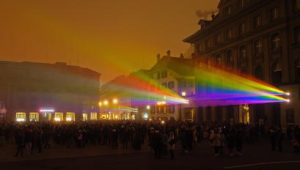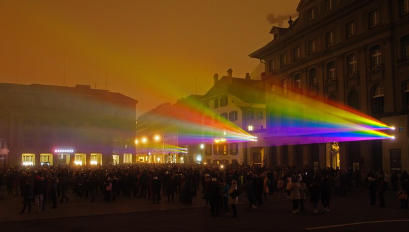
In laser projector performances, we can see a variety of colors such as red, orange, yellow, green, cyan, blue and purple, and even mixed white light. So, how do laser lights produce these rich and colorful colors? The core lies in the control of “wavelength” and the principle of RGB primary color mixing.
The color of a laser is determined by its physical wavelength. Light of different wavelengths appears as different colors to the human eye. Early lasers mainly relied on gas media. For example, helium-neon lasers produce the classic red light at 632.8 nanometers, and argon ion lasers produce blue light at 488 nanometers and green light at 514.5 nanometers. However, gas lasers are large in size and low in efficiency, and have gradually been replaced by solid-state and semiconductor lasers.
Modern laser lights mainly use semiconductor laser diodes (LDs) as light sources. By changing the chemical composition of semiconductor materials (such as gallium arsenide, gallium nitride, etc.), the energy level difference of electron transitions can be precisely controlled, thereby directly emitting red light (about 638nm), green light (about 520nm) and blue light (about 450nm) of specific wavelengths. Among them, the research and development of green lasers was once a major difficulty. In the early stage, frequency doubling technology was required to convert infrared light into green light, which was relatively inefficient; now, the technology of diodes that directly emit green light has matured, greatly improving the brightness and stability of green lasers.
With these three primary color lasers—Red, Green, and Blue (RGB)—laser lights can perform additive color mixing by adjusting the intensity ratio of the three lasers, just like a TV screen. Mixing red and green light produces yellow light, mixing green and blue light produces cyan light, mixing red and blue light produces magenta light, and mixing the three in equal amounts produces white light. The laser control system rapidly modulates the intensity of these three light beams at a speed of thousands of times per second, and cooperates with a high-speed scanning galvanometer to draw dynamic patterns of thousands of colors in the air, creating a dreamlike visual feast.