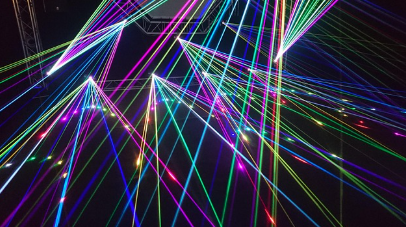
Today, whether it is the G20 Hangzhou Summit Cultural Performance or major star concerts, domestic stage laser lights occupy a dominant position. But few people know that decades ago, China’s stage laser light industry was completely dependent on imports.
Before 2000, almost all domestic stage laser lights were imported from Germany, the United States, Italy and other countries. Core technologies (laser modules, galvanometer systems, control software) were controlled by others. Only a few large-scale celebrations could use imported equipment, with a market size of less than 10 million yuan and almost zero market share of domestic equipment.
From 2001 to 2010, domestic laser lights began to take off. Enterprises such as Guangzhou Caiyi and Shenzhen Guangxiang Technology successively launched independent products. Although there was a gap with international brands in terms of power and stability, they quickly opened the mid-to-low-end market with price advantages and localized services. In 2010, the market share of domestic equipment increased to 35%, and the market size reached 230 million yuan.
From 2011 to 2020, domestic laser lights achieved technological breakthroughs. Technologies such as high-power full-color modules, high-speed galvanometers, and DMX512 protocol control gradually matured. In 2016, at the G20 Hangzhou Summit, domestic laser lights successfully achieved precise integration of water screen and laser, marking that domestic equipment has been recognized internationally. In 2020, the market share of domestic equipment exceeded 68%, and the export volume exceeded 150 million US dollars.
Today, China’s stage laser light industry has entered the stage of intelligent development. Functions such as AI-assisted pattern generation and wireless remote control are accelerating. The market size has reached 1.86 billion yuan. It not only meets domestic demand, but also is exported to Southeast Asia, the Middle East and other regions, realizing a leap from “dependence on imports” to “global leadership”.